
- Things People Sleep In That Are Not Beds
- High Up, Where Nobody Looks
- Inside Things
- The Routes Between Rooms
- Why These Get Missed
- What This Means for a Failed Treatment
If you have read how bedbugs choose a harbourage, the logic here will be familiar: dark, tight on several sides, and as close to a sleeping person as possible. What follows is that logic applied to the places people forget are close to a bed.
Things People Sleep In That Are Not Beds
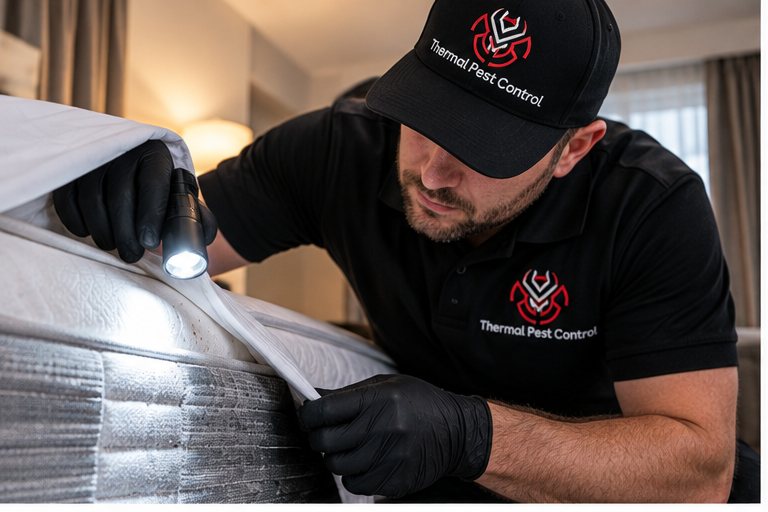
The single largest category of missed harbourage, because the inspection was booked for a bedroom.
- Recliner chairs — the mechanism housing underneath is dark, tight and almost never looked at. In a home where someone dozes in a chair, this is frequently the main population
- Sofas where somebody has been sleeping since the problem started
- Sofa beds, in the folded mechanism as well as the mattress
- Wheelchairs and mobility chairs — cushions, seams and the frame joints
- Car seats, for anyone who spends long periods in a vehicle. Uncommon, real, and never checked
High Up, Where Nobody Looks
Bedbugs are usually described as staying low. In an established infestation where the harbourages near the bed are crowded, they spread upward and outward, and a room that looks clear at knee height can be busy at picture height.
- Picture frames and the wall behind them
- Curtain hems, pelmets and the top of a curtain pole
- Coving, and any gap where it has come away from the wall
- Smoke alarms and light fittings — dark, warm and undisturbed
- The top edge of a wardrobe and the gap above it
Inside Things

- Alarm clocks and radios on a bedside table. A warm object within a metre of a head is close to ideal
- Books, in the spine and between pages, on a bedside shelf
- Plug sockets and light switches, behind the faceplate
- Telephone and cable entry points where they pass through a wall
- Anything screwed to the wall with a gap behind it — a headboard, a shelf bracket, a TV bracket
The Routes Between Rooms
In flats and terraces these matter as much as the harbourages, because they explain how a neighbour's problem becomes yours.
- Pipe runs where they pass through a wall or floor
- Cable and conduit entries
- The void under a floorboard at the skirting line
- Gaps around a service riser in a block
- Under a connecting door with no sweep on it
Why These Get Missed
Not usually laziness. Three structural reasons:
- The inspection was scoped to a room. The recliner is in the lounge, so nobody looked at it
- The obvious harbourage was found early. Once there are bedbugs in the divan, the temptation is to stop searching and start treating
- Nobody asked the right question. 'Has anyone been sleeping anywhere else?' finds more missed harbourages than any amount of torchwork
What This Means for a Failed Treatment
If a treatment did not hold and it was not a hatching issue, the probability is high that one of the above was never treated, because it was never found.
That is why a re-inspection after a failure is worth more than a repeat treatment. Applying the same product to the same places a second time addresses none of it.
Related Questions
Do bedbugs live in carpets?
Not in the open pile, which is too exposed. At the carpet edge where it tucks under the skirting, frequently — that is a tight dark gap and it counts.
Can bedbugs live in clothing you are wearing?
No. Unlike lice they do not live on a person. They will travel in a bag or a coat left on an infested surface, which is a different thing.
Do they get into electrical items?
Into the housings of things that sit near a bed, yes — alarm clocks and radios especially. Into a laptop in a living room, very rarely.
Bedbug Inspections London — Advice
Everything else written up for this service, and the service page itself if you would rather just get a price.
Tell Us About the Property
Tell us what you have seen and where, and we will tell you what it needs.