
- 1. Has It Reached More Than One Room?
- 2. Has Anyone Moved Where They Sleep?
- 3. How Fast Do You Need the Room Back?
- 4. Has Something Already Been Tried?
- 5. What Is in the Room, and Who Is In It?
- When the Answer Is Both
- The Short Version
People arrive at this question expecting one treatment to be better than the other. Neither is. They fail in different ways and suit different situations, and the useful exercise is working out which situation you are in.
1. Has It Reached More Than One Room?
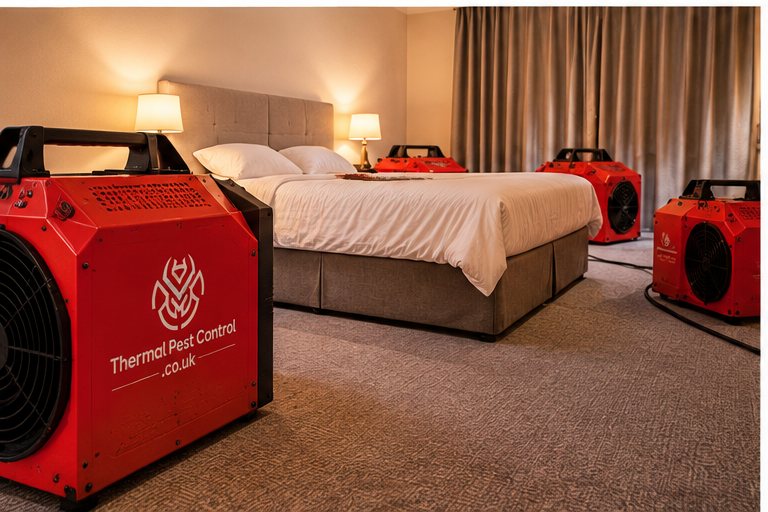
This is the question that decides it most often. One bedroom, everything still around the bed, nothing dragged through the property — chemical is proportionate and we will say so.
The moment a second room is involved, the maths changes. Chemical means treating both, twice, with a fortnight between, and any gap in coverage reseeds the other room. Heat deals with the whole area in one pass.
2. Has Anyone Moved Where They Sleep?
If someone has given up on the bedroom and moved to the sofa, the living room is now part of the problem whether or not anyone has seen a bedbug in it. Bedbugs follow the sleeper.
That single behaviour turns a one-room job into a two-room job more often than anything else, and it usually points at heat.
3. How Fast Do You Need the Room Back?
Chemical does not take the room away from you — you can sleep in it the same night — but it does put you in a two to three week cycle with a technician returning.
If you are a household, that is normally fine. If you are a hotel, a landlord between tenancies, a serviced apartment, or someone with relatives arriving, a single day is worth paying for.
4. Has Something Already Been Tried?
A property where one or two chemical treatments have not held needs a different approach rather than a third go at the same one. Sometimes that is a resistance problem, sometimes a missed harbourage, sometimes a source nobody has found. Heat resets the room regardless of which it was.
It is also worth an inspection first, because a treatment that failed for a reason will fail again for the same reason.
5. What Is in the Room, and Who Is In It?
Heat needs heat-sensitive items out: aerosols, candles, medication, vinyl, some electronics, instruments. A room full of things that cannot be moved is a room heat suits less well.
Running the other way, a household that would rather have no residual product left anywhere — because of a baby, an allergy, a fish tank, or simple preference — usually lands on heat for exactly that reason.
When the Answer Is Both
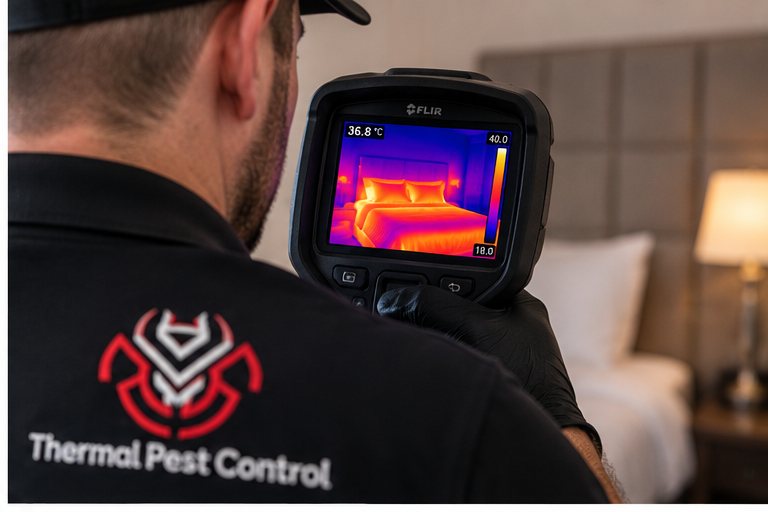
More often than people expect. Heat clears the room completely but leaves nothing behind; a light residual along the skirtings and entry points afterwards covers the one thing heat cannot, which is something walking back in from next door.
In a flat with shared walls, an HMO, or a block where more than one unit is affected, that combination is usually what we recommend.
The Short Version
- One room, caught early, budget matters — chemical
- Two or more rooms, or someone has moved to the sofa — heat
- Room has to go back into use immediately — heat
- A previous treatment did not hold — inspection, then heat
- Shared walls or a building with other affected units — heat plus a residual
← Back to Bedbug Heat Treatment London · Bedbug Control London
Related Questions
Is heat treatment worth the extra money?
When it saves you a second and third visit, a fortnight of worry and the risk of it spreading to another room, usually yes. On a single contained bedroom caught early, often not, and we will tell you.
Can I start with chemical and move to heat if it does not work?
You can, and plenty of people do. It costs more overall than going straight to heat, so it is worth being honest with yourself at the start about how far it has really spread.
Bedbug Heat Treatment London — Advice
Everything else written up for this service, and the service page itself if you would rather just get a price.
Tell Us About the Property
Tell us what you have seen and where, and we will tell you what it needs.