
- What Heat Actually Does to a Bedbug
- Why the Eggs Die Too
- Where the Heat Has to Reach
- Why the Fans Matter as Much as the Heaters
- What It Does Not Do
A bedbug is a small animal with a very large surface area for its volume, no ability to sweat, and nowhere to go when the whole room is the problem. Those three facts are what heat treatment exploits.
What Heat Actually Does to a Bedbug
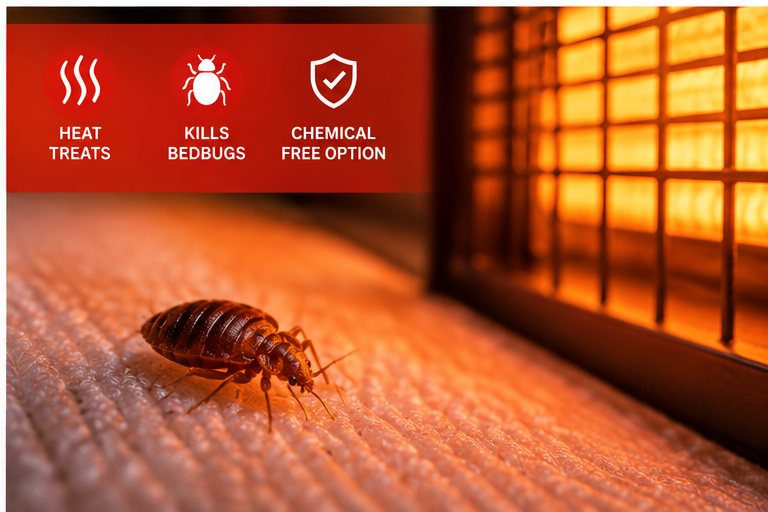
Insects are not warm-blooded. A bedbug sitting in a mattress seam is whatever temperature that seam is, and it has no mechanism for being any cooler than its surroundings. Push the surroundings past a certain point and the proteins that run its cells begin to come apart.
That process is not a switch, it is a curve. Slightly above the survivable temperature, a bedbug dies slowly. Well above it, it dies in minutes. This is why the number that matters in a heat treatment is never the peak reading on a thermometer — it is temperature multiplied by time, held steadily, in the place the insect actually is.
The insect also cannot outrun it in a sealed room. It can move away from a warm patch, which is exactly what it will try to do, and that is why the room is brought up as a whole rather than a corner at a time. A bedbug driven ahead of a heat gradient into a cold wall void is a bedbug that survives.
Why the Eggs Die Too
A bedbug egg is roughly a millimetre long, pearl white, and glued into a crack with a cement the female produces. It is coated to stop it drying out, and that coating is very good at its job.
It is also very good at keeping a liquid insecticide out, which is the single reason chemical treatment needs a second visit. Spray an egg and the residue sits on the shell. The embryo inside carries on developing, hatches a week or two later, and has to walk across the treated surface before anything happens to it.
Temperature does not work that way. Heat is not a substance that has to get through a barrier; it moves through the shell exactly as readily as it moves through the mattress the egg is stuck to. The embryo reaches the same lethal temperature as the adult in the same pass, in the same room, on the same afternoon.
Where the Heat Has to Reach

Air heats quickly and means almost nothing. The places bedbugs live are dense, insulated and slow: the inside of a mattress, the middle of a timber bed frame joint, the gap behind a headboard bolted flat to a solid wall, the underside of a divan sitting on carpet.
Those places lag the air temperature by a long way and catch up slowly. A room that hit temperature in forty minutes may need several more hours before the inside of the divan base has got there, and the treatment is not finished until it has.
This is what the probes and the thermal camera are for. The camera shows the cold spots as dark patches — behind furniture, under heavy items, inside built-in wardrobes — and those are precisely the places a treatment fails if nobody looks.
Why the Fans Matter as Much as the Heaters
Hot air left alone stratifies. It sits at the ceiling and leaves the floor, the skirting and the back of the wardrobe well behind, which is unfortunate because that is where the bedbugs are.
Circulation fans keep the air moving so the heat is delivered evenly and driven into the gaps rather than pooling at head height. A heat treatment with no fans is a room that feels hot and a mattress that is not.
What It Does Not Do
Heat has no memory. Once the room has cooled it is an ordinary room, with nothing in it that would trouble a bedbug walking in from somewhere else. In a house with one affected bedroom that does not matter. In a converted flat, a block where the neighbours have the same problem, or an HMO where people move between rooms, it matters a great deal — and in those cases a light residual goes along the edges after the heat so something is waiting.
← Back to Bedbug Heat Treatment London · Bedbug Control London
Related Questions
Is heat treatment better than chemical treatment?
For eggs and for speed, yes. For cost, no. Heat finishes it in one visit and reaches every life stage; chemical costs less and does the job perfectly well on a contained single room, provided you accept the follow-up visit.
Does heat treatment work on a mattress you cannot move?
It is one of the situations heat is best at. The mattress does not need to be moved, lifted or disposed of — the heat goes through it where it lies, which is not something a surface spray can claim.
Can bedbugs build up resistance to heat?
No. Resistance is something that happens to chemistry, where a population carries a gene that lets it metabolise a particular compound. There is no equivalent for temperature; an insect either reaches a lethal temperature or it does not.
Bedbug Heat Treatment London — Advice
Everything else written up for this service, and the service page itself if you would rather just get a price.
Tell Us About the Property
Tell us what you have seen and where, and we will tell you what it needs.