
- The Rough Shape of a Day
- What Makes a London Property Slow
- What Makes It Quick
- When Can You Use the Room Again?
- Why We Give You a Window Rather Than a Time
The honest answer is that a heat treatment takes as long as the coldest part of the room takes to come up to temperature and stay there. Everything below is really a list of things that make that point arrive sooner or later.
The Rough Shape of a Day
- Setting up — getting equipment in, removing what has to come out, placing heaters, fans and probes. Under an hour in a bedroom; longer in a property with stairs and no lift.
- Bringing the room up — usually one to three hours, and the single most building-dependent part of the day.
- Holding it — several hours, because this is where the mattress core and the frame joints catch up with the air.
- Monitoring and chasing cold spots — running throughout, and occasionally the reason a treatment runs long.
- Cooling and making good — an hour or so, plus putting back anything we isolated.
What Makes a London Property Slow
Solid walls
A Victorian or Edwardian conversion with solid brick walls is a thermal sponge. The walls absorb heat for hours before the room stabilises, and in a mid-terrace the neighbours get some of it. Modern stud partitions come up far faster.
High ceilings
A period first-floor flat with three-metre ceilings has a great deal more air to heat than a new-build box with the same floor area, and the heat wants to sit at the top of it. That is volume, not area, and it costs time.
Sash windows and draughts
An original sash leaks continuously. Heating a room that is quietly venting to the street is a slower job and occasionally a longer one than the floor area suggests.
Heavy and built-in furniture
A solid divan on a thick carpet, a fitted wardrobe against an outside wall, a headboard bolted flat to brick. Each one is a cold spot that has to be brought up individually, and each one adds time.
How many rooms
Two connected rooms take longer than one but not twice as long, because much of the setting up is shared. A whole flat is usually a full day and sometimes runs into the evening.
What Makes It Quick
- A modern flat with stud walls and standard ceiling heights
- A single room, caught early, with the problem still around the bed
- Furniture that can be pulled away from the walls before we arrive
- Good access — a lift, or a ground floor, rather than four flights
- A room already cleared of the heat-sensitive items on the list we sent
When Can You Use the Room Again?
The same evening in almost every case. The room needs to come back down to a temperature you would want to sleep in, which takes an hour or two with the windows open, and then it is yours. There is no drying time, no airing-out period and no residue to avoid.
That is the reason hotels choose heat even though it costs more than chemical: one room, one day out of inventory, back on sale that night.
Why We Give You a Window Rather Than a Time
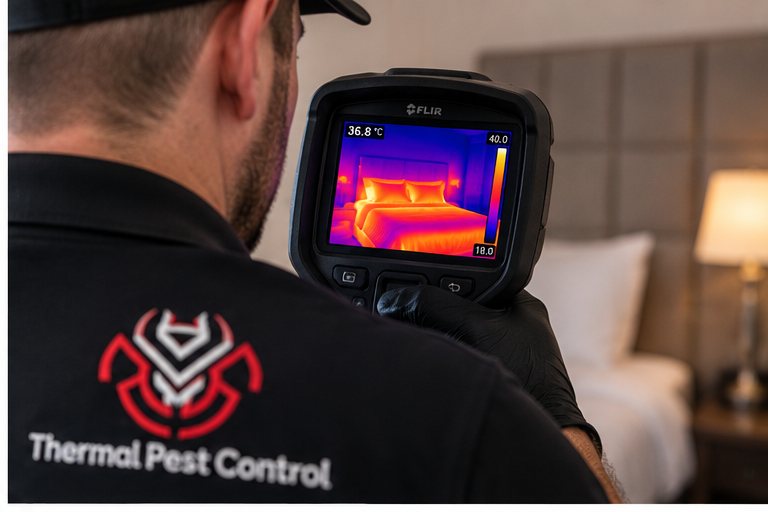
Because the honest figure depends on what the thermal camera says at four o'clock, not on what the floor plan said at nine. A company that promises a fixed finish time before it has seen the room is either very confident or about to leave early.
← Back to Bedbug Heat Treatment London · Bedbug Control London
Related Questions
Do I need to take the whole day off?
You need to be out of the treated room and the ones either side while it is at temperature. Most people arrange to be out for the day and come back in the evening.
Can you do it at a weekend or in the evening?
Yes, and for a lot of London properties that works better. It costs no more in most cases.
Is a second visit ever needed after heat?
Not usually. Where one is, it is normally because the problem had already reached rooms that were not treated, which is something an inspection beforehand would have found.
Bedbug Heat Treatment London — Advice
Everything else written up for this service, and the service page itself if you would rather just get a price.
Tell Us About the Property
Tell us what you have seen and where, and we will tell you what it needs.