
- What a Bedbug Is Actually Looking For
- So the Treatment Goes Here
- Where We Deliberately Do Not Treat
- What This Means If You Are Looking Yourself
A bedbug is not hiding at random. It is solving a very specific problem, and the solution it arrives at is predictable enough that we can go straight to it.
What a Bedbug Is Actually Looking For
Three things, in this order.
Darkness
They move away from light, which rules out every open surface in the room. This alone is why spraying the visible face of a mattress accomplishes so little.
Contact on as many sides as possible
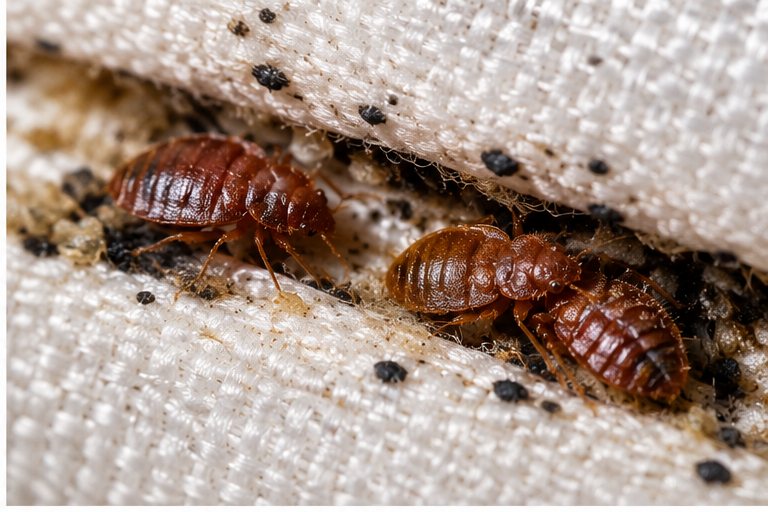
This is the one people do not know, and it explains nearly everything. A bedbug wants to be touching a surface with its back as well as its feet — wedged, not merely hidden. A crack it can just squeeze into is far more attractive than a comfortable open gap.
It is why they are found in seams rather than on fabric, in joints rather than on timber, and behind things rather than under them.
Close to the sleeper
They feed at night on someone who has been still for hours, and they prefer not to travel far. Most of any population is within two metres of where the head goes. That is the search radius, and it is why the sofa becomes a problem the moment somebody sleeps on it.
So the Treatment Goes Here
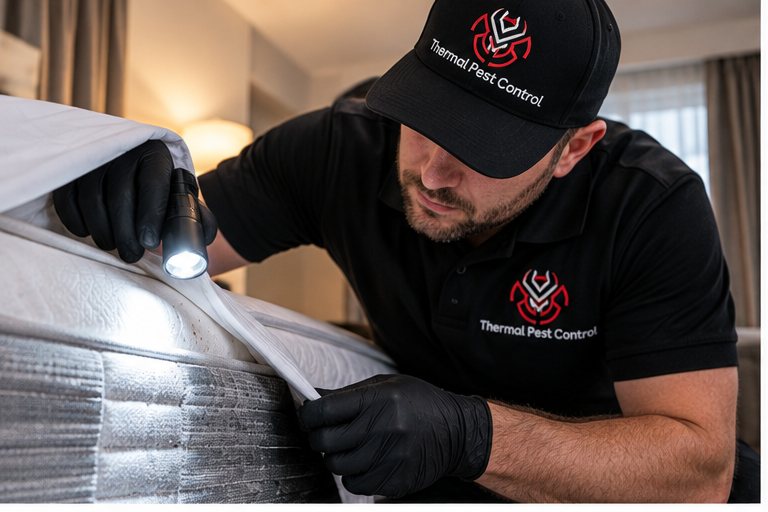
In order of yield rather than the order you would guess:
- Mattress seams, piping and the label pocket — dark, tight on several sides, and inches from the host
- The divan base — underside, corner vents and the inside of the frame. Routinely the largest single population in a room
- Every joint and screw hole in the bed frame — the screw holes especially; they are exactly the right size
- Behind and inside the headboard — a buttoned one is close to ideal habitat
- Bedside furniture — drawer runners, the back of drawers, the gap between carcass and wall
- Skirting boards and the carpet edge where it tucks under, within that two-metre radius
- Socket faceplates, light switches and loose wallpaper
- Upholstered chairs and curtain hems if there are any in the room
Where We Deliberately Do Not Treat
Just as informative, and worth knowing so you can tell a thorough job from a theatrical one.
- Open floor and open wall surfaces — bedbugs do not linger there and the product is wasted
- The sleeping surface of the mattress — you sleep on that. Seams and piping, yes; the face you lie on, no
- Inside wardrobes full of clothing — we treat the structure, you deal with the contents by washing hot and drying hot
- Anywhere a child or a pet has direct prolonged contact unless there is a specific reason and a product suited to it
- The whole house, when the problem is one bedroom. Treating rooms that do not need it is cost without benefit
What This Means If You Are Looking Yourself
Take a torch, go to the bed, and work the list above in order. Do not start with the carpet in the middle of the room, and do not conclude anything from a clean-looking mattress top.
Lift the corner of the divan and look into the frame. Unscrew nothing, but look into the screw holes. Pull the headboard forward. That is where the answer is, in nearly every property we go to.
← Back to Bedbug Chemical Treatment London · Bedbug Control London
Related Questions
Do you treat the whole house?
Only where the whole house needs it. Treating rooms with no evidence in them costs you money and achieves nothing, and we would rather spend the time searching properly in the rooms that do.
Will you move my furniture?
We will pull it out and put it back. What we would rather you did not do is move it across the property beforehand, which is how a one-room problem becomes a two-room one.
Do you treat electrical sockets?
Around and behind faceplates, with an appropriate dust rather than a liquid. It is a classic harbourage and a classic missed one.
Bedbug Chemical Treatment London — Advice
Everything else written up for this service, and the service page itself if you would rather just get a price.
Tell Us About the Property
Tell us what you have seen and where, and we will tell you what it needs.